A common model for AI writing support is straightforward: paste your draft, receive a better one. We noticed this resembles a failure mode that universities dealt with decades ago, specifically in writing centers, places where students will go to receive peer feedback on their writing. This led us to wonder whether the problem might not be the technology itself, but the design philosophy behind it.
In the 1940s, university writing centers functioned as fix-it shops: students brought broken prose, staff or students returned polished prose. By the 1980s, the field had realized this was counterproductive. The shift followed toward writer-centered, non-directive, process-oriented support, and these principles are now foundations of writing center pedagogy. It is also, almost entirely, absent from how AI writing tools are designed.
This work aims to close that gap. Through interviews with ten writing tutors, we translated writing center pedagogy into seven design guidelines, then built Writor – a prototype that provides feedback grounded in those principles, without generating sentences you can copy-paste into your draft. Finally, we evaluated our system with domain experts to understand the pedagogical soundness and potential for such tools to be integrated into existing writing support ecosystems.
Seven guidelines from the literature and the tutors
| # | Guideline | Dimension |
|---|---|---|
| G1 | Empathetic, confidence-building feedback | Writer-centered |
| G2 | Preserve the writer’s voice | Writer-centered |
| G3 | Use examples and analogies | Process-oriented |
| G4 | Reader-perspective feedback | Process-oriented |
| G5 | Align feedback to writing prompts | Process-oriented |
| G6 | Conversational feedback | Collaborative |
| G7 | Meet writer’s needs | Collaborative |
What Writor Looks like
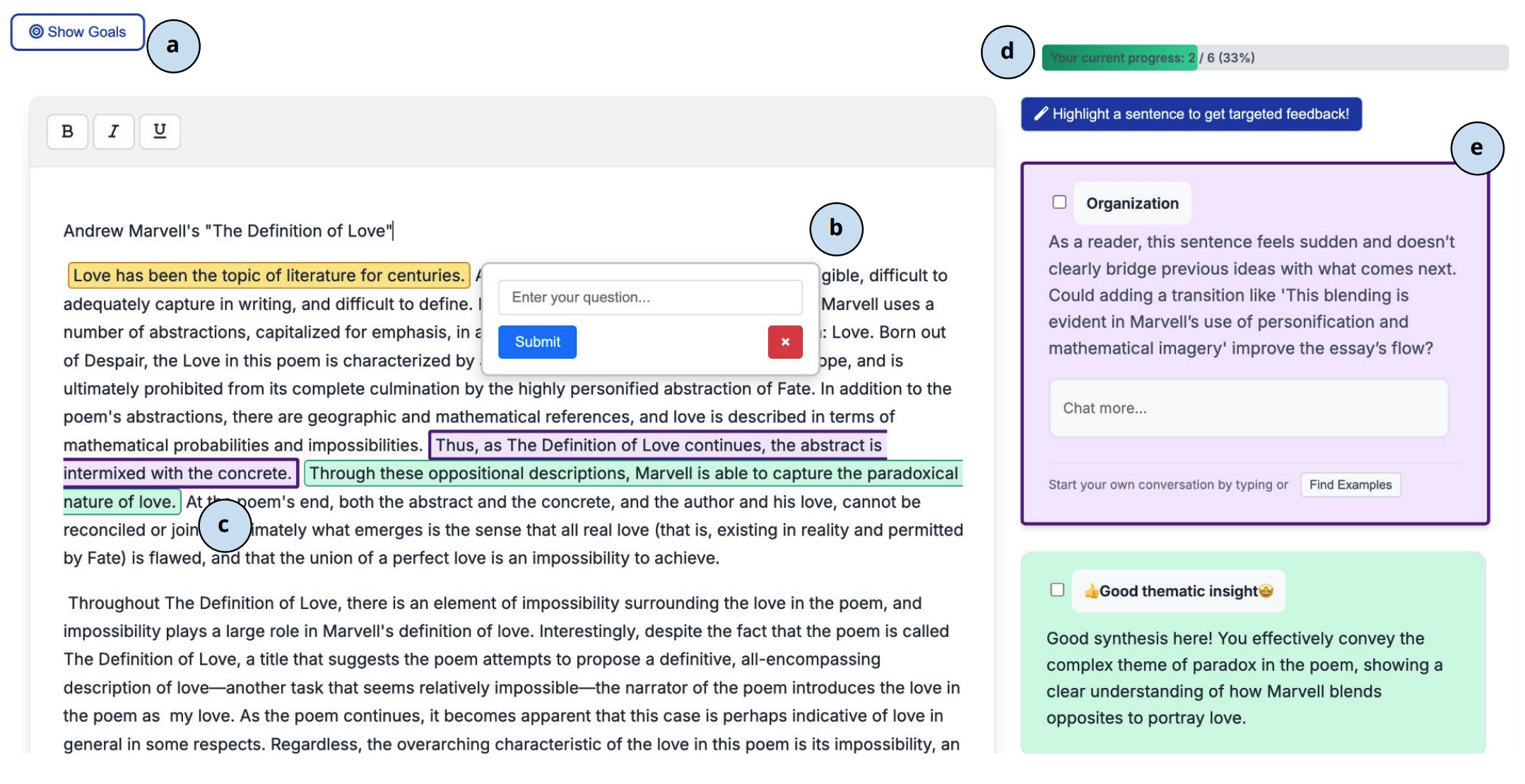 (a) Expandable button for viewing selected writing goals; (b) Highlight & Get Feedback for user-initiated analysis; (c) Interactive highlighting that connects feedback to specific text; (d) Progress bar for tracking addressed feedback items; (e) Critique and praise cards.
To evaluate whether these principles translate from theory to practice, we recruited thirty domain experts – writing instructors, writing center tutors, and AI researchers – for a structured review of Writor’s feedback.
The finding that stayed with us
“The people who were most skeptical of AI in writing liked Writor the most.”
Participants with explicitly negative attitudes toward AI in writing consistently rated Writor as better than standard generative AI tools. This was not the group we expected to receive positive feedback from. Their concern was that AI removes the human thought from writing. Writor’s non-directive design meant that it didn’t, and they noticed.
One thing to take away
The skepticism educators feel toward AI writing tools is not, at its core, a rejection of technology. It is a rejection of a design philosophy that prioritizes task completion over the writer’s development. The good news is that a different philosophy already exists as decades of writing center practice. Grounding AI design in that tradition doesn’t just produce better tools. It may be the most direct path toward earning the trust of the educators we most need on board.
From Crafting Text to Crafting Thought: Grounding AI Writing Support to Writing Center Pedagogy Co-Authors: Yijun Liu, John Gallagher, Sarah Sterman, Tal August